
TL;DR
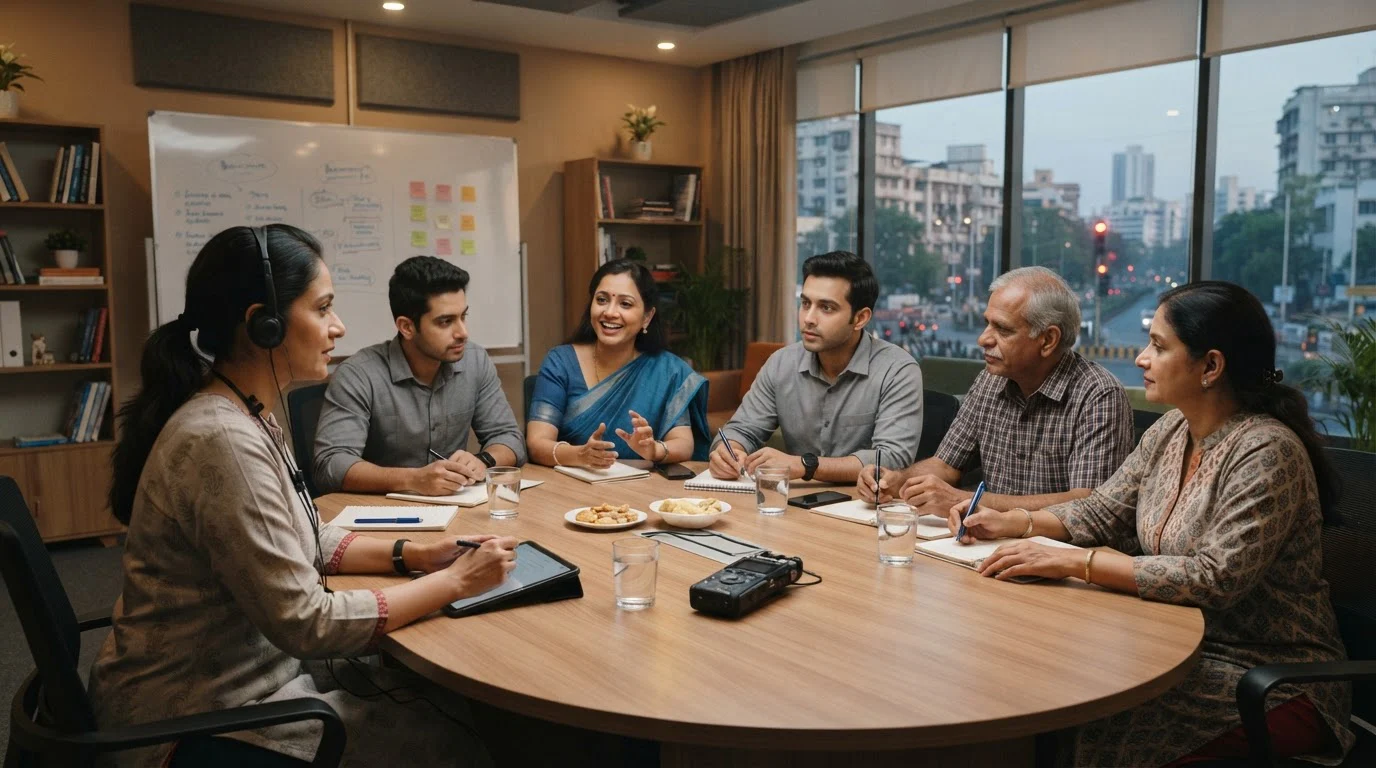
Start with one business decision, then recruit comparable participants into groups of 6 to 8 people and plan 3 to 4 groups for each priority participant category. In India, screen for real category experience and preferred discussion language, separate people when status could silence them, use a neutral moderator and note-taker, and report themes without turning them into market percentages.
Start with one business decision. Then recruit 6 to 8 people per comparable group and plan 3 to 4 groups for each priority participant category, adding groups only when new themes still change the decision. India’s FGD toolkit supports those starting ranges.
A focus group helps a company hear how customers explain a choice, react to a concept, and disagree with peers. It does not tell you what percentage of India agrees. Use a survey when the decision needs prevalence, sizing, or a representative estimate.
What Decision Should a Focus Group Answer?
Write the decision before writing the screener. A useful brief starts with this sentence:
“After this research, we will decide [action] for [audience or market] because we need to understand [unknown belief, barrier, language, or trade-off].”
For example: “After this research, we will decide which onboarding message to launch for first-time investors in Bengaluru because we need to understand which risks and benefits they find believable.”
That sentence determines every later choice. It tells you whether to recruit current users or prospects, whether Bengaluru needs its own cell, which language to screen for, and what the moderator must probe.
Use a focus group when peer interaction is part of the evidence. Customers can build on an idea, reject it, or reveal the words they use when talking to people like themselves. Use individual interviews when someone needs privacy or when another participant’s opinion could change the answer.
For prototype behaviour, use moderated usability testing. For repeated habits over days, use digital diary studies. For what people do in their own setting, consider digital ethnography.
When Are Focus Groups the Right Research Method?
A focus group is most useful for an early decision. It helps you find unmet needs, map a buying journey, test early concepts, improve language, or identify why an offer feels credible or confusing.
Choose an FGD when you need to learn:
- How people describe a category in their own words.
- Which objections are shared and which divide the group.
- How a concept, package, message, or service proposition lands.
- What people expect from a purchase or service experience.
- Which assumptions should go into a later survey.
Choose individual interviews instead when the topic is sensitive, confidential, highly personal, or shaped by unequal power. India’s DMEO guidance specifically warns that mixed groups can inhibit participation where gender, age, or authority affects who can speak freely.
How Many Focus Groups and Participants Do You Need?
Plan by decision-relevant participant cells, not by one impressive-looking total. A cell is a group of people who need separate treatment because their role, experience, market, or language could change the business action.
Use this planning table before you commission recruitment.
| Research Objective | Participant Mix | City And Language | Starting Fieldwork |
|---|---|---|---|
| Find unmet needs | Current users and prospects separate | One launch market per cell | 6 to 8 people, 3 to 4 groups |
| Test a concept | Same category and purchase role | Separate language cells when meaning changes | 6 to 8 people, 3 to 4 groups |
| Explore sensitive experiences | Similar status and gender where relevant | Private, comfortable local setting | 4 to 6 people, 3 to 4 groups |
| Understand B2B buying | Users, approvers, buyers separate | One account market per cell | 6 to 8 people, 3 to 4 groups |
| Compare priority markets | Same eligibility across markets | One market-language cell each | 6 to 8 people, 3 to 4 groups |
The table means a study of current users and prospects in two decision-critical markets can require four separate cells. Do not merge those cells merely to reduce the group count if the planned action differs by customer type or market.
The 3 to 4 group starting point is useful because it gives the team a review point. The DMEO toolkit recommends 3 to 4 groups for a participant category, continuing if later groups reveal new information. An empirical saturation study found that 3 to 6 groups can surface most themes in a homogeneous population, but deeper meaning often requires more fieldwork.
Put an interim review after group three in the project plan. Review new themes, unresolved differences, and whether every decision-critical cell has appeared in the evidence.
How Should You Recruit Focus-Group Participants in India?
Recruit people because they have the experience your decision needs, not because they are easy to reach. Your screener should verify the participant’s category use, purchase role, recency, location, discussion language, and availability.
Include these fields in the recruitment brief:
- Category qualification: Define what the person has done recently. For example, “bought health insurance in the past 12 months” is stronger than “interested in insurance.”
- Purchase role: Separate primary buyers, users, influencers, approvers, and channel partners when their decisions differ.
- Participant exclusions: Exclude people connected to the client, competitors, advertising, market research, or the study team where that could bias discussion.
- Research recency: Set a recency exclusion and enforce it. The DMEO sample screener uses six months as an example for prior FGD participation.
- Language: Ask which language the participant is comfortable using for a group discussion. Do not infer it from city, education, or phone number.
- Consent and incentive: State the session length, incentive, payment timing, recording plan, and participation conditions in the invitation.
A panel, community organisation, customer list, public call, or local recruiter can all produce candidates. The recruitment source should match the audience. A customer list can work for known users. A specialist recruiter may suit difficult B2B profiles. A public call can expose a sensitive study topic and attract unsuitable volunteers.
Budget each line item separately: recruitment, screening, participant incentive, venue or platform, moderator, note-taker, translation, transcription, analysis, and reporting. A buyer should request this scope instead of relying on a generic per-group market estimate.
If recruitment is the constraint, start with participant recruitment platforms for India to match the source to your audience risk.
Which Cities and Languages Should You Include?
Choose cities because the business decision needs them. Choose languages because participants need them.
Start with the launch market, retention problem, sales territory, or product rollout that created the research question. Add a second market only when a different market could lead to a different action.
For each market, decide whether a separate language cell is necessary. Create one when a translated concept, local vocabulary, cultural reference, or buyer journey could change how participants interpret the material.
India’s Census language resource shows why city labels are not enough for language planning. The moderator and note-taker must understand the language respondents actually use. The DMEO toolkit warns that weak language capability can break the flow of discussion and distort the record.
Localise these materials before fieldwork:
- The screener.
- The invitation and consent wording.
- The discussion guide.
- Any concepts, ads, prototypes, packaging, or service scripts.
- The transcript labels and translation notes.
Keep source-language quotes in the analysis file. Translate them for the report, but retain the original wording where the phrasing itself matters.
How Do You Write a Discussion Guide That Avoids Leading Answers?
Build a guide that moves from lived experience to reaction. A 60 to 90 minute group needs fewer, better questions than a survey.
Use this sequence:
- Welcome: Explain the purpose, duration, voluntary participation, recording, and group rules.
- Warm-up: Give every participant one easy question to answer.
- Category experience: Ask what they do today, when they do it, and what makes it difficult.
- Decision drivers: Probe for needs, risks, alternatives, triggers, and trade-offs.
- Individual stimulus reaction: Let each person react before hearing the group.
- Group discussion: Ask who agrees, who disagrees, and what changed their view.
- Close: Ask what the team failed to ask and what should change.
Replace leading questions with neutral prompts:
- Instead of “What do you like about this app?”, ask “What was your first reaction to this app?”
- Instead of “Would this feature solve your problem?”, ask “Where, if anywhere, would this feature fit into what you do now?”
- Instead of “Is the price too high?”, ask “What would make this feel worth paying for?”
The moderator should ask one question at a time, protect quieter participants, and invite dissent. The DMEO moderation guidance requires moderators to remain neutral and avoid leading questions.
Use a separate note-taker. Audio or video helps fill gaps, but the note-taker should capture pauses, agreement, confusion, and who responded to whom. Get consent before recording and explain why the recording is needed.
What Should a Useful Focus-Group Report Include?
A useful report ends in a decision, not a transcript. It should show the client what changed across groups and what action follows.
Require these sections:
- The original business decision and research questions.
- The participant cells, recruitment source, exclusions, and attendance.
- Cities, language used, moderator, note-taker, and fieldwork dates.
- The discussion guide and stimuli tested.
- Themes by participant cell, including agreement and disagreement.
- Evidence excerpts with identities protected.
- A clear recommendation, owner, and next action.
- Limits on what the research can claim.
Do not convert group comments into percentages. The DMEO reporting guidance says FGD results should be reported qualitatively and should not be presented as representative of a population.
At Qualfacto, our research panel includes Focus Groups, described as guided discussions with 5 to 7 peers about brand concepts, services, and technology trends. If you are preparing a fieldwork brief, use our guide to choosing a focus group partner before selecting the recruitment and moderation setup.
FAQs
Can Client Stakeholders Observe a Focus Group?
Yes, if observers do not participate or alter the room’s comfort. Tell participants about observation and recording during consent, then keep client questions for the moderator debrief after the session.
Can One Focus Group Test Several Concepts?
Yes, but collect individual first reactions before discussion begins. Rotate concept order across groups so the first concept does not gain an advantage from novelty or attention.
Can Focus Groups Be Conducted Online?
Yes, especially for digitally comfortable participants who are geographically dispersed or time-constrained. Keep the group comparable, test the platform before fieldwork, and use explicit turn-taking so poor connectivity does not silence quieter participants.
Should Participants Know the Incentive Before They Join?
Yes. State the amount, payment timing, completion conditions, and payment method in the invitation. Clear incentive terms reduce avoidable dropouts and prevent the moderator from negotiating during fieldwork.