3 companies compared
Participant Recruitment Platforms India That Match Audience Risk
Audience access and research risk matter more than a generic claim of speed. This ranking compares publicly documented India coverage, recruitment route, screening controls, study fit and a current price or incentive benchmark.

By Jitendra Kumar Nirala, Founder · Updated 7 Oct 2026
On this page
The short answer
The best participant recruitment platforms India buyers use are not interchangeable. Choose UserQ for priced remote unmoderated testing, choose our qualitative panel for India-based qualitative study formats, and choose Prolific for screened adult online research when a small India pool is acceptable.
The shortlist
How we ranked them
- Audience fit and India coverage
- Recruitment route
- Screening and quality controls
- Price or incentive benchmark
- Fit for remote, qualitative or specialist research
The companies in detail
UserQ
A remote-testing platform with India panel access and a published per-response price.
- Recruitment route
- Panel access for UserQ tests and external moderated studies
- India coverage
- India and 100 other countries
- Quality checks
- ID check, tester score and criteria matching
- Price basis
- UserQ panel pricing page, 2026
UserQ wins for teams that need priced, remote unmoderated tests and can run the study in the platform’s English or Arabic test experience.
Strengths
- India panel access for remote user testing
- More than 20 screening criteria, including custom screening questions
- Prioritises recruitment using ID check, tester score and criteria matching
- Credits can be refunded for reported poor responses
Limitations
- Its public test-language experience is English or Arabic, so it is not the fit for every Indian-language study.
- Its core offer is remote testing, not a substitute for managed in-person fieldwork.
Qualfacto
Our qualitative panel supports research formats that extend beyond a short online test.
- Recruitment route
- Qualitative panel and participant recruitment
- India coverage
- India-based participant community
- Onboarding
- Mobile or WhatsApp verification and consented video introduction
- Study formats
- Interviews, focus groups, home visits, online discussions and product experience
Our own platform wins for teams recruiting India-based participants for qualitative formats such as interviews, focus groups, home visits, shop-alongs and product testing.
Strengths
- We support interviews, focus groups, home visits, online discussions and product-experience sessions.
- Our onboarding uses mobile and WhatsApp verification for invitations and verification.
- Participants consent to a short video introduction used for their profile and study matching.
Limitations
- The public onboarding includes mobile or WhatsApp verification and a video introduction, so it is not designed for a short anonymous online survey.
- Our public participant offer is built around qualitative study participation rather than a simple self-serve test panel.
Prolific
An online research pool with several hundred filters and a documented small India population.
- Recruitment route
- Online participant pool
- India coverage
- Small participant population
- Eligibility
- Participants are at least 18
- Price basis
- Prolific minimum reward policy, August 2026
Prolific wins for adult online studies that need structured filters and can accept a small India participant pool, not for teams needing broad India feasibility or fieldwork.
Strengths
- Several hundred filters cover demographics, language, employment and other attributes.
- Prolific says it automatically verifies age and current country of residence.
- The platform documents ongoing identity and quality controls.
Limitations
- Prolific describes India as a small participant population.
- All participants must be at least 18, so it cannot recruit children.
- Most filter answers are self-reported.
How to choose
- 1
Ask where the sample originates
Ask whether participants come from the provider’s own panel, another panel or a blend of sources. Source mix can vary by project and country. - 2
Check validation twice
Check how the provider validates participants at onboarding and again at study entry. The second check matters for duplicate, hacked and shared accounts. - 3
Treat professional audiences separately
Consumer-panel questions are necessary for quality review, but ESOMAR’s online-sample guidance does not cover B2B samples. Request a project-specific explanation of professional-status checks. - 4
Specify geography and language
State the target location, language, session mode and accessibility needs before asking for recruitment feasibility. India is not one uniform language market. - 5
Confirm participant history
Ask how often the same person can participate and whether the provider tracks past participation. Repeated participation can introduce fatigue or professional-participant bias. - 6
Agree privacy and consent handling
For screeners collecting personal data, confirm the participant notice, consent process, support channel and method for withdrawal before fieldwork begins.
Quality checks need to work at registration and study entry
ESOMAR’s buyer guidance recommends asking how a provider ensures participants are real, unique and accurately profiled, then asking how those controls work when a person enters a specific study. The guidance calls out duplicate accounts across channels or panels, hacked accounts and shared household accounts as risks worth testing. Read the guidance
For a qualitative project, add a project screener that checks the behaviour, recency and role that actually matter to the research question. A generic demographic profile cannot establish that a person recently used a product or holds the professional responsibility your study needs.
A national brief still needs local detail
The Census of India reports 22 languages in the Eighth Schedule and 121 languages with at least 10,000 speakers. The Census language statement supports a practical rule: name the target geography and required interview language instead of treating “India” as a sufficient participant specification.
If the study involves extended self-reporting, a longitudinal task or observed behaviour, consider whether a diary study or digital ethnography fits the question better than a one-off interview.
High-information screeners need a clear consent path
India’s Digital Personal Data Protection Rules, 2025 were published on 13 November 2025, with commencement staged by rule. When Rule 3 applies, the notice must use clear, plain language, identify the personal data and purpose, and provide a way to withdraw consent and exercise rights. The government notification sets out those requirements.
Keep the first contact proportional to the study. Ask only for the information needed to assess fit, explain why it is needed, and collect more sensitive detail only when the research design requires it.
Map the source before you buy
The recruitment route determines the checks you need. A customer list, consumer panel, specialist source and managed recruiter have different strengths, so compare the source before comparing the interface.
Choose the recruitment route before the platform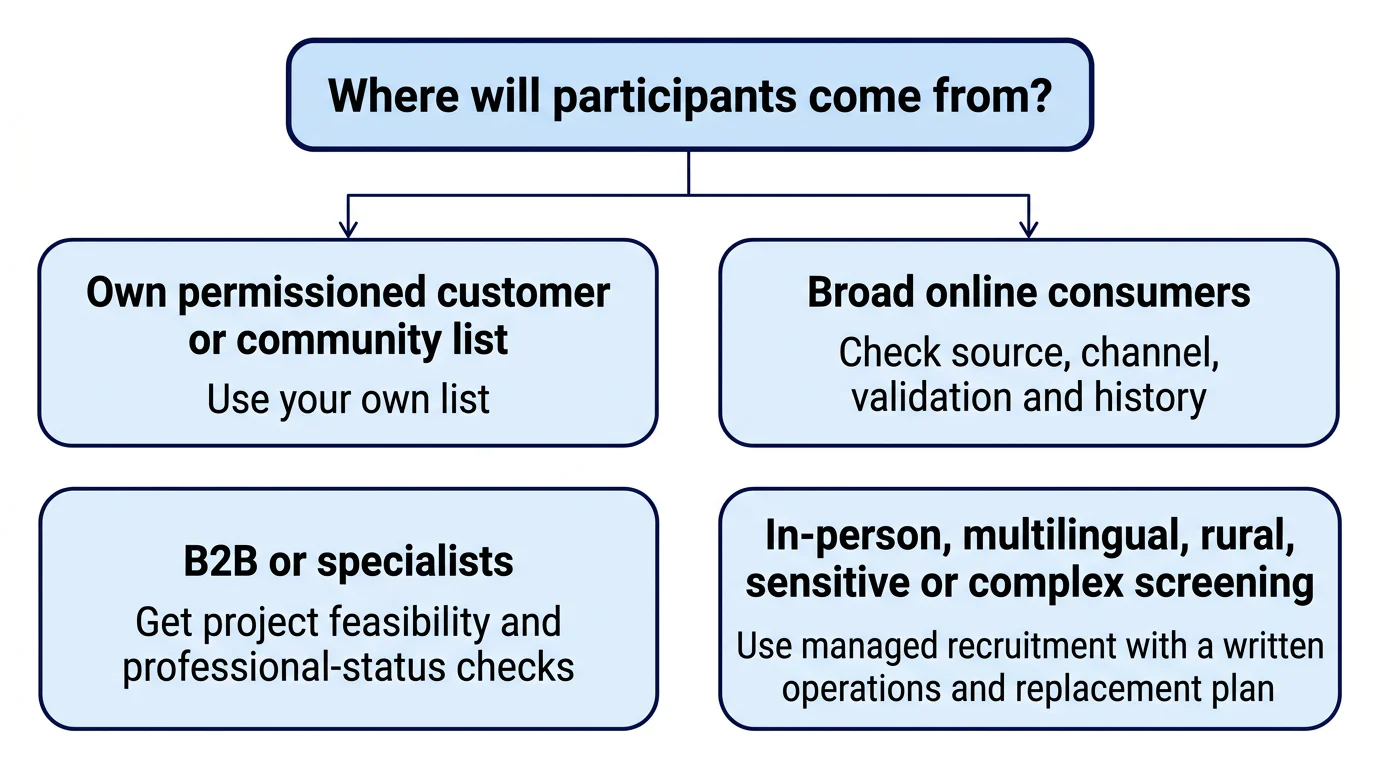
For studies that need group discussion, use this alongside our guide to choosing a focus group partner.
How we built this list
What separates a panel from a recruitment route
A panel is a database of people who have indicated willingness to take future research, generally for an incentive. ESOMAR’s 2021 buyer guidance also identifies customer lists, social media, affiliate networks, loyalty communities and intercepts as possible sources.
That distinction matters. Use your customer list when you need known users. Use a consumer panel when you need broad online reach. Use a specialist source when professional status matters. Use managed recruitment when the project needs in-person work, language support, rural reach or complex screening.
For a method-first view of the wider tool stack, see which UX research tools fit your study.
This page is published by qualfacto. If anything here is out of date, tell us and we will correct it.
Sources
- 1.Questions to Help Buyers of Online Samples, ESOMAR / Market Research Society of India, 2021
- 2.Census of India 2011 Language Statement, Office of the Registrar General & Census Commissioner, India, 2018
- 3.Digital Personal Data Protection Rules, 2025, Ministry of Electronics and Information Technology, Government of India, 2025